
07.03.26 • Moss Utilities
What Is a Duct Bank? A Plain-English Guide to Concrete-Encased Conduit
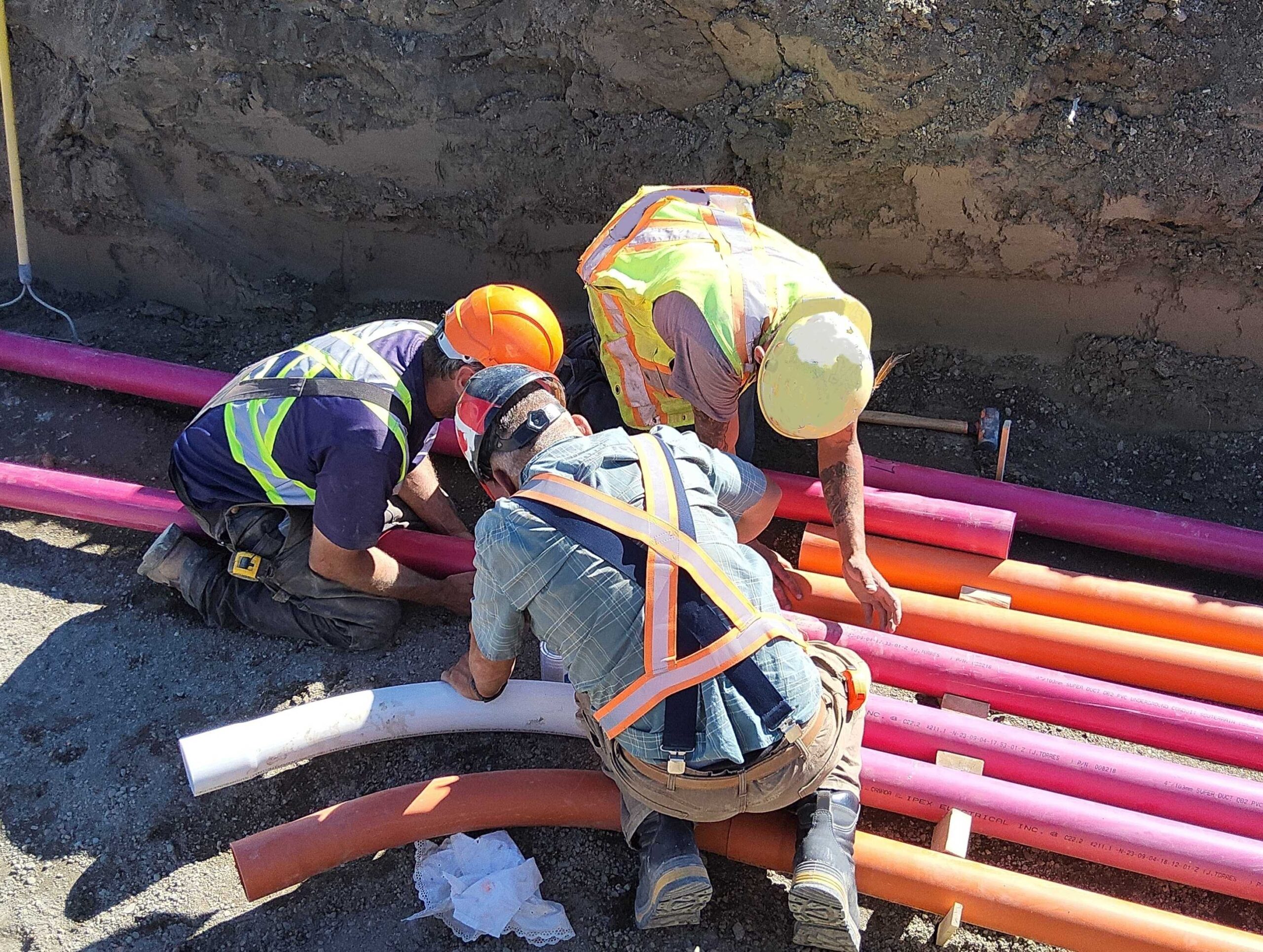
It is common to use concrete-encased conduits for utility installation, and the proper design and configuration are critical for long-term performance. Typically, a duct bank is used to group the conduits together so that the power, fiber, and communication utility lines can be organized and protected in one utility trench.
What is a Duct Bank: The Plain-English Definition
To put it simply, a duct bank is a set of underground conduits that are placed together. These conduits are organized and arranged in rows and columns, and then the whole system is surrounded by a concrete encasement.
The same duct bank can hold conduits for multiple types of utilities, including power, fiber, and communications. But even though all of the lines are included in the same bank, separate conduits are used within that encasement to avoid interference.
This utility installation method is different than direct burial. If you are using a direct burial method, then the cable or conduits are placed into the ground without a concrete encasement around the system.
Why Contractors Use Duct Banks Instead of Direct Burial
Even though direct burial is simpler and cheaper, there is a much higher risk of complications using this method in the soil conditions here in Texas. Every experienced utility contractor knows that the shrink-swell cycles of the clay soil can cause damage to utility infrastructure. So, the preference is to place a concrete encasement around the cables to reduce the risk of mechanical damage and crushing loads when the clay expands.
When the conduit is encased, building codes allow for a shallower burial depth. As a result, we can reduce the amount of excavation that is needed, which helps to offset the overall costs for utility installation.
Additionally, using a single trench with duct bank construction is much easier compared to digging multiple trenches. In this situation, all of the different conduits can be safely placed in the same trench, eliminating the need to have utility placements in multiple locations.
What Are Duct Banks Actually Made Of?
Most electrical duct bank installation projects involve these common materials:
- PVC Conduit: The PVC is available in both Schedule 40 and Schedule 80, which are the most common types of materials for standard duct bank installations.
- HDPE and Fiberglass (RTRC): These conduits are commonly used when you need longer cable pulls. Additionally, these materials are recommended for high-heat environments.
- Rigid Metal Conduits: There are times when it makes sense to use rigid metal materials, such as placement at a stub-up where the conduit moves from the ground up into a building or vault.
The Proper Configuration for Duct Bank Design
Depending on the number of conduits your project needs, the duct bank will be designed in rows and columns (for example, 2×2 or 4×4). Most of the time, these designs increase the capacity beyond immediate requirements, offering future expansions up to 25-33% more if needed. This future planning allows additions to be made without the need to excavate the utility trenches again.
Duct bank depth requirements and spacing guidelines between the conduits must follow local code. Spreading things out helps with managing the heat buildup between the cables, which reduces the risk of long-term damage and complications.
The Basic Build Sequence for Duct Bank Installation
Every project is unique, which is why there isn’t a one-size-fits-all solution for designing a duct bank. But there are common best-use strategies that can be implemented into the design. This is the process that we typically follow, with customizations to accommodate each site’s unique needs:
- Trenching: First, the trench is surveyed, marked, and dug to the required depth and width. We’ll make sure that the trenching specifications align with the bigger-picture building plans.
- Conduits: Next, the conduits are placed on spacers and stacked to ensure that everything is spaced properly. Before the concrete can be poured, the conduits are secured with rebar to hold them in place.
- Final: Once the concrete has cured, we pull through a mandrel to make sure that each conduit is clear. Then, the trench can be backfilled. Tracer wires are in place to help with future locating as needed.
The Most Common Ways Duct Banks are Used in DFW
Duct banks are not required for every project. Here are some of the most common scenarios that might use duct banks:
- Data Centers: Because of the technology and infrastructure, data centers rely on duct banks to handle redundant power routing. The right design helps to protect uptime.
- Substations, Communities, and Campuses: Larger projects such as master-planned communities, schools, or hospitals need a sufficient utility structure to handle everything. Duct banks are commonly used for these types of projects.
- Multiple Utilities: No matter the type of construction, if multiple utilities need to be placed in the same area, then it’s standard practice to use a duct bank since it is more economical than digging separate trenches.
FAQs
What is a duct bank used for?
Duct banks are placed in the ground to protect and organize underground cables, including power, fiber, and communication. The lines are organized together in a concrete-encased area.
What’s the difference between a duct bank and direct burial?
With a direct burial, the cables are placed straight in the ground, and separate trenches are needed for the different types of utility lines. On the other hand, a duct bank holds all of the utility lines in one place, with a concrete encasement for protection.
How deep does a duct bank need to be?
The required depth specifications depend on the jurisdiction where the duct bank is installed, as well as the voltage that will be running through the utility lines. When duct banks are used instead of direct burial, a shallower depth can be used.
What is the typical lifespan of a duct bank?
A well-designed, durable duct bank typically has a lifespan of 30-40 years.
Moss Utilities Offers Expert Services for Underground Utility Work
Hiring the right contractor is one of the most important decisions you will make to ensure success with your underground utility work. Our team at Moss Utilities has extensive experience with duct banks and trenching, offering customized solutions for every project.
Contact us for a consultation to discuss your scope of work and see how we can help. We are always just a phone call away.